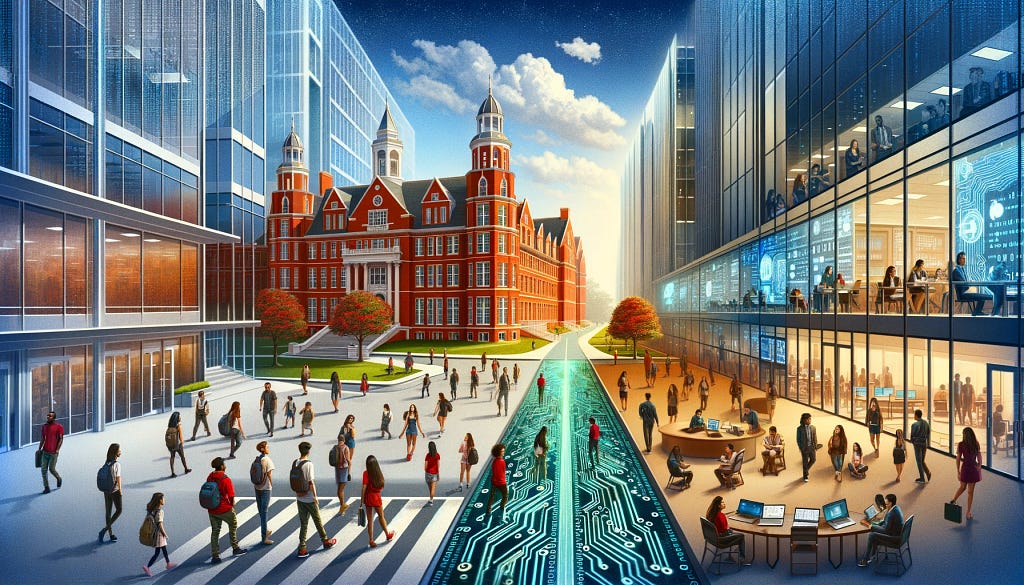
I’ve been reading Ta-Nehisi Coates book, Between the World and Me. It relates a father’s wisdom about the world to his son, as a black man growing up in America.
In the book, he relates his experience with Howard University, “The Mecca”; which, for multiple generations of his family, represented a place where black Americans, long oppressed and neglected, could strive to reach a higher position (in a white society).
Founded in 1867, just two years after the end of the Civil War, and chartered by the US Congress, Howard was to be a place of higher education open to all, regardless of race. This was a time where Harvard was to only then admit its first student to earn a degree there, and MIT would not admit a black student for another 20 years.
Despite its long history, I would not become aware of Howard until I was an adult. I had taken my computer science degree from MIT to get a job as a programmer in the early days of Microsoft. It was a tradition at Microsoft to send our engineers to recruit for new talent to fill our rapidly growing ranks.
We frequented all the “top schools” for engineering and computer science; MIT, Stanford, CMU, Harvard, Cal Tech, etc. But, by the 1990’s we were not only having trouble meeting our demand for new talent, but we were also coming to realize how little diversity our engineering teams had.
Almost all software developers at Microsoft were white and male up until then; yes, there were a few women in our ranks — but it was quite the exception (most of the women at Microsoft at the time served in other roles like testing, technical writing, sales, marketing, or secretarial jobs).
And African Americans were even more scarce. Not only was Microsoft located in a part of the country with a very small black population, but all of the elite schools we recruited from were also greatly unrepresentative (and even more so in the computer science departments of those schools).
So, one day, I was asked if I would substitute one of my regular trips to recruit at MIT, and instead visit Howard University. I didn’t know what to expect, but I agreed and was eager to help Microsoft’s diversity in hiring.
As Microsoft Developers, we prided ourselves as having a very objective process for recruiting engineers. Contrary to other fields, we did not ask questions to determine if applicants came from a “good background”, or a “good family”. We prided ourselves and asking objective questions about engineering — could this person do the work. We nominally didn’t even care about grades or degrees.
Our style was to give applicants a practical programming problem to solve. We want to see you “write code”; and we de-emphasized learning just how you got to the place you were now.
In hindsight, I view this as a very narrow approach which measured just a single dimension of a person’s abilities and potential.
Suffice it to say, Howard was not preparing its students to do well with our interview format at the time. I talked to a dozen students, and was only able to recommend bringing a single person back to Redmond for further interviews — and that person was to interview for a position in testing, and not as a software developer.
To be fair, most colleges and universities did not have very strong computer science programs in the 1990’s. Even though computer programming as a career had existed for several decades, I don’t think anyone anticipated the massive explosion of the opportunities that were about to become available with the success of the personal computer, and later, the Internet.
At the time, I would say I was disappointed in my lack of success recruiting at Howard. But I think my response, which was to blame Howard for poorly preparing its students, was not the one I would aspire to today.
Companies like to pay lip service to increasing diversity in their workforce, but don’t often look deeper into the root causes for the apparent lack of candidates from underrepresented populations.
There is a reason that students whose families have a history of professional employment are much more represented in the elite schools that give them the same opportunities as their parents. They have been exposed to role models from a very early age. They are able to see what they can become, and the path they need to take to do so. And they typically have much more access to enrichment in their education; like having a computer at home, with a parent who can show them how to use it.
Only recently, have I noticed programs to widen the net for the kind of high-paying software development jobs that are available (where a starting salary of $100,000 is over twice as high as the median American man’s salary). Code.org comes to mind as a program that strives to expose every American child to some form of computer science education.
I’m afraid the divide between those with the most opportunities, and those historically underrepresented in high technology fields is only going to grow naturally wider. The advent of Artificial Intelligence has the potential to radically change the employment picture for software engineers. Without thoughtful programs of inclusion, it can allow an elite few to vastly increase their productivity and edge out the need to have a larger workforce. It could even displace even the most privileged engineering students in the near future.
When I was at Google (late in my career), I saw a company very dedicated to the elimination of unintentional bias in the hiring process. They were as equally objective and analytical as Microsoft, if not more so. Yet, I believe Google has long recognized that their hiring protocols are not good indications of an employee’s future success or impact in the company. Yet tech firms largely rely on the same formula that Microsoft pioneered in the 1980’s for the technical interview.
So, perhaps one way to increase diversity is to have a broader interpretation of the “intangibles” that we for so long ignored. Companies should recognize that the most successful employees are going to:
- Be highly motivated.
- Work well in teams.
- Be inspiring to others.
- Have a strong sense of curiosity and imagination for the future.
- Be enthusiastic and avid learners.
- Have a deep compassion and empathy for the customers to be served.
Employers shouldbe more interested in a candidate’s personal history. What is the context by which they have come to the place they are? Have they gotten there in spite of the lack of role models or access to enhanced learning opportunities? How have they been able to adapt to adversity?
Minority candidates may have many more opportunities to demonstrate their resilience than the stock technical interview affords them today. If employers will just listen, they may be able to enrich their workforce with multi-dimensional employees who can bring so much more value than just knowing how to write a for-loop.
Mike Koss was an engineer at Microsoft for 20 years, developing consumer products such as Excel, Outlook and SharePoint. He later worked at Google developing tools to help other developers deliver mobile and web applications. He recently spent one year running a program to educate underrepresented minorities to career-switch into software development roles — 2,000 students signed up for the program in its first year.
Originally published on Medium on November 13, 2023.