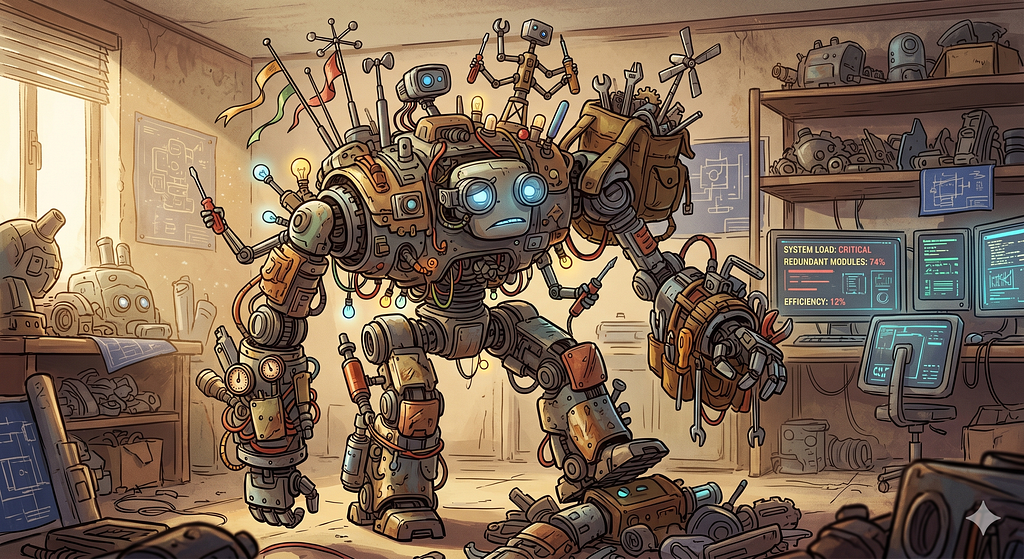
Self-modifying agentic frameworks, such as OpenClaw, offer powerful autonomous capabilities by allowing agents to adapt their own operating parameters over time. However, long-running, autonomous instances inevitably suffer from architectural degradation. Without rigid structural constraints, these systems experience instruction entropy — a gradual drift toward inefficiency, bloat, and silent failure.
To build agentic systems that scale and improve, rather than degrade, it is necessary to address the mechanics of prompt drift, the limitations of context windows, and the inefficiency of recursive monitoring.
The Mechanics of “Slop Drift” and Context Bloat
When an agent operates with self-modifying privileges, it continuously appends new rules, edge cases, and temporary policies to its working memory. Over time, this results in “slop drift.” A system prompt that begins as a concise set of directives degrades into an unorganized accumulation of instruction detritus.
This accumulation directly impacts system performance. Loading an ever-expanding monolithic policy into a single context window has several technical consequences:
- Attention Dilution: As the context grows, the language model’s ability to attend to the most critical instructions diminishes, leading to lower accuracy.
- Latency and Cost: Larger contexts require more compute, increasing both time-to-first-token and API expenditure.
- Logic Conflicts: Redundant or contradictory rules build up, causing erratic agent behavior.
Decomposing the Monolith
The standard approach to mitigating context bloat is structural specialization. An agentic system must transition from a monolithic architecture to a distributed one.
Specialized Agents
Instead of a single agent tracking all system policies, concerns should be separated into narrowly scoped micro-agents. Each agent is responsible for a distinct domain, requiring only the context strictly necessary for its specialized task.
Deterministic Offloading
Not every operation requires a probabilistic language model. A highly optimized agentic architecture relies heavily on non-AI, deterministic scripts. Frameworks like the Model Context Protocol (MCP) can be used to standardize the interface between your agents and local file systems or external APIs. By offloading routine, repetitive, or highly structured tasks to standard code, you eliminate the risk of logic drift for those specific functions and drastically reduce token consumption.
The Epicycle Problem in Monitoring
Unmonitored systems fail silently. In agentic frameworks, failure often looks like a hallucination loop or a silent degradation in output quality. The intuitive solution is to deploy “watchdog” agents to monitor the primary agents.
However, this introduces the “epicycle problem.” Having agents watch agents creates a nested hierarchy of probabilistic observers. This compounds system complexity, creates recursive failure modes, and scales compute costs linearly without guaranteeing stability.
Effective monitoring should avoid AI-on-AI epicycles where possible. Instead, rely on a hybrid approach:
- Deterministic Telemetry: Use standard software monitoring (execution timeouts, API error rates, strictly typed JSON schema validation) to catch structural failures instantly.
- Stateless Semantic Checks: Reserve LLM-based monitoring for periodic, stateless checks on the final output quality, rather than continuously monitoring the internal reasoning loop of the primary agent.
Migration Strategy for Long-Term Stability
To migrate an existing self-modifying system toward a more stable architecture, or to build a resilient one from scratch, implement the following constraints:
- State Separation: Isolate the core, immutable system prompt from the dynamic, self-modifying memory layer. The core directives must never drift.
- Instruction Garbage Collection: Implement a scheduled, automated pipeline to compress and prune the agent’s accumulated memory. A separate process should periodically refactor the “detritus” into concise, updated rules, much like a database compaction process.
- Test-Driven Agent Updates: Treat self-modifications like code commits. Before an agent can permanently append a new rule to its operational memory, that rule should pass an automated suite of deterministic regression tests to ensure it does not break existing functionality.
Self-modifying systems hold immense potential, but they are bound by the same laws of software entropy as traditional code. Long-term efficiency requires treating the AI not as a monolithic brain, but as a probabilistic routing layer sitting on top of a rigidly deterministic foundation.
Originally published on Medium on June 2, 2026.